
Molly Nagle
Representing Adolescence Blog Post #2
Upon entering Special Collections, I had little knowledge or interaction with many first edition prints. Seeing pocket sized Charlotte Temples gave powerful insight into how accessible and convenient the book was during its prime. Life Magazine provided significant cultural details that highlighted the changes in advertisements, fashion, and social entertainment. What largely caught my attention was in the Gender in Youth Literature section— Lois Gould’s 1978 work, X: a fabulous child’s story. My first impression of the book perfectly paralleled topics, such as gender identity and people’s agency, that were raised in our class discussions as well as my gender studies seminar course. I found it fascinating that Gould effectively captured a topic as difficult as gender identity, especially in the 1970s when identities that didn’t fit social norms were not widely accepted. Interacting with these first edition texts presented me with a better appreciation for an author’s original work and the unique images illustrated by Jacqueline Chwast.
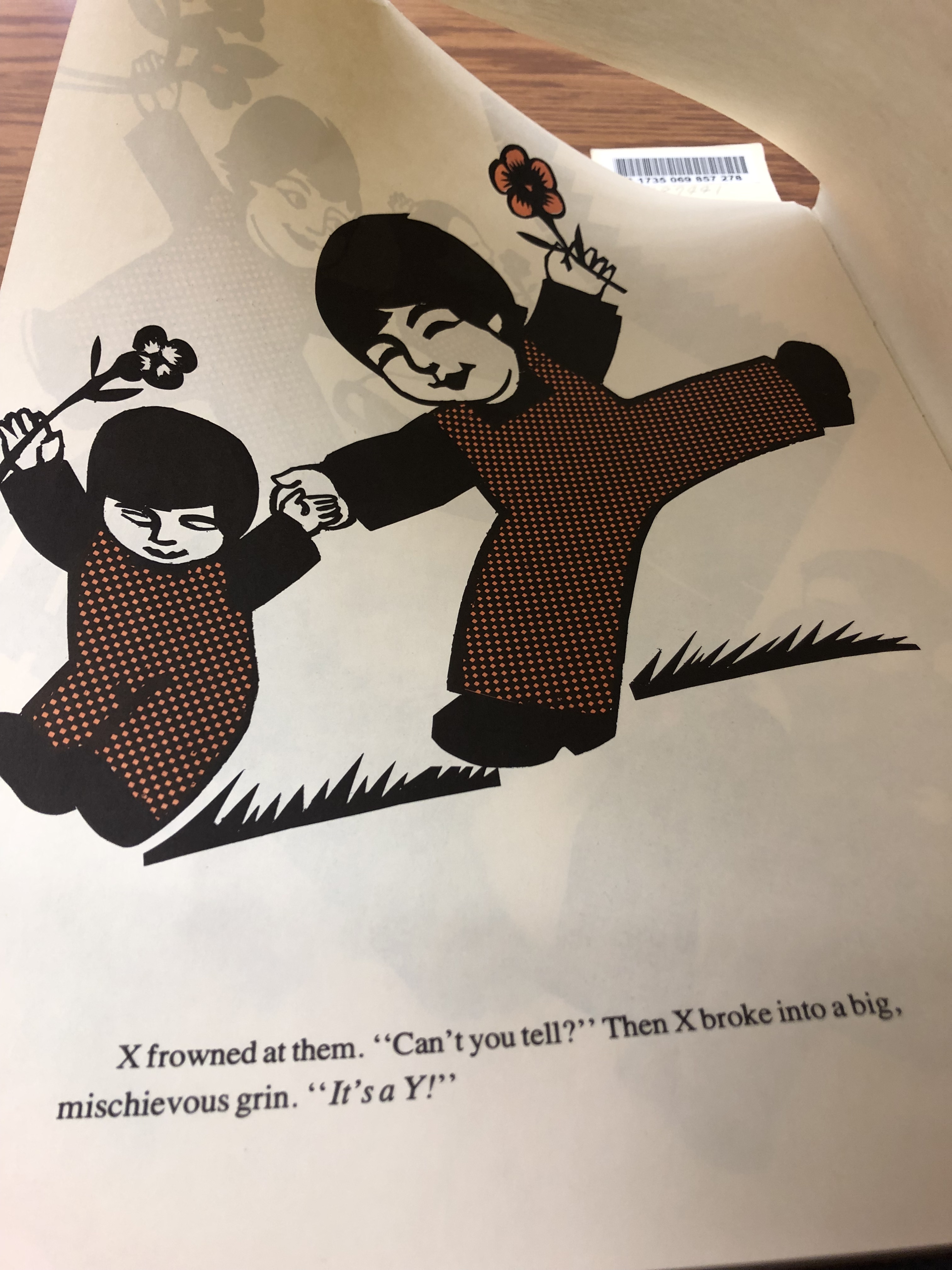
As a primary source print, X: a fabulous child’s story is a fairy large book in relatively good condition. A plastic, protective outer sleeve covers the slightly tared layer on top of the hard, bound cover. The pages are made of thick, sturdy paper which improves the longevity of the material. What sparked my interest about the original print is the pictures and the word font. Both display what Gould and Chwast intended readers to appreciate, rather than someone else’s adaptation in a reprinted version (like our pdf of Charlotte Temple rather than Susanna Rowson’s primary pocket size edition). The illustrations also emphasize the importance of the “X”; every “X” is capitalized throughout the story. This carries a certain weight to it. Not only is this a clever literary technique relating to the title, but it reveals gender identity as the significant theme with many characteristics about gender that people are ignorant towards. The images are also only in three colors— black, white, and orange. “Black and white” is a universal phrase that people use to completely separate things but the pop of orange brings to light the gender theme in easily depicted images. The orange colored fragments symbolize major gender identifiers, one main one being the orange checkered overalls that don’t distinguish X’s gender. In reissued versions, the true value of these illustrations could be partially missed or completely removed.
This book displays several differences when compared to the other magazines, newsletters, and comics we viewed in Special Collections. First, X: a fabulous child’s story was quite progressive for its time. Gould broke boundaries for gender identity by venturing into this usually ignored area. By not giving the child a gender, she allows the child to act, feel, and just exist the way they want without judgement for being one gender or another. Even though X’s classmates and their parents didn’t initially accept their unspecified gender, X was able to play and decide an identity for themselves. This contrasts the strict culture template that most comics and magazines follow for their respective time periods. Authors and editors of these materials rarely pushed limits for inclusion of all people, rather they firmly trailed the social norms of the times. Life Magazine published in the mid- 1900s almost never featured people of color because racism was alive, especially during the 60s with the Civil Rights Movement. Gould’s book was a very interesting read because I was able to identify and agree with the inclusive theme of gender identity. Similarly, X: a fabulous child’s story definitely sold the idea that gender is not something someone should be forced into. By participating in the “Xperiment”, X was allowed express themselves in a free environment. I think a stereotype of “you can only be one gender” was poked at throughout the book, exposing the judgement and inaccuracy of what gender identity should be about.
This is book is accessible to any reader and is important for everyone to learn the messages it is presenting. There isn’t just a single point in life when your identity is evaluated and decided. People constantly change opinions, gain more experience, and take more control over their decisions, so your self- opinion may change between childhood, adolescence, and adulthood. Since the title says “child’s story”, the author probably intended children to be sole investors in the narrative, but gender identity affects all ages and people’s perceptions of their own agency. Details given from the cover and pictures didn’t present an overwhelming sense of being produced in a particular area. The themes and images are straightforward and it’s useful as a universal story. It also fits in well with the collection around it. It presents issues that face people, particularly adolescence (in the context of our class), just like the other short stories. The Secret Language and Harriet the Spy include similar aspects, such as exploring sexuality and dealing with agency when surrounded by heteronormative conditions. X: a fabulous child’s story became a major basis for many other gender and sexuality inclusive stories.
Call Number: P27.G7352 Xac

 Representing Adolescence @ Pitt
I also was surprised to see the subject of gender nonconformity in such a dated piece. While the book was published in the 1970s, which don’t seem very long ago, gender identity is something that many people (sadly) still have trouble understanding and accepting to this day, so it was interesting to see someone be so open and accepting about it back then. Personally, I had the impression that gender nonconformity was an issue that only began to openly be discussed recently, but from your post and the book I was able to learn that some have been talking about it for almost 50 years now.
I wonder if there is a specific reason that the author chose to use orange as the unisex color, even though there are many colors that are seen as generally non-gender specific, like green, red, yellow, etc. Maybe there isn’t a real reason, but I am curious.
– Emily Mears
LikeLike